
Player Cats: The 2 AM Zoomies Aren't Random. Here's What They're Actually Telling You.
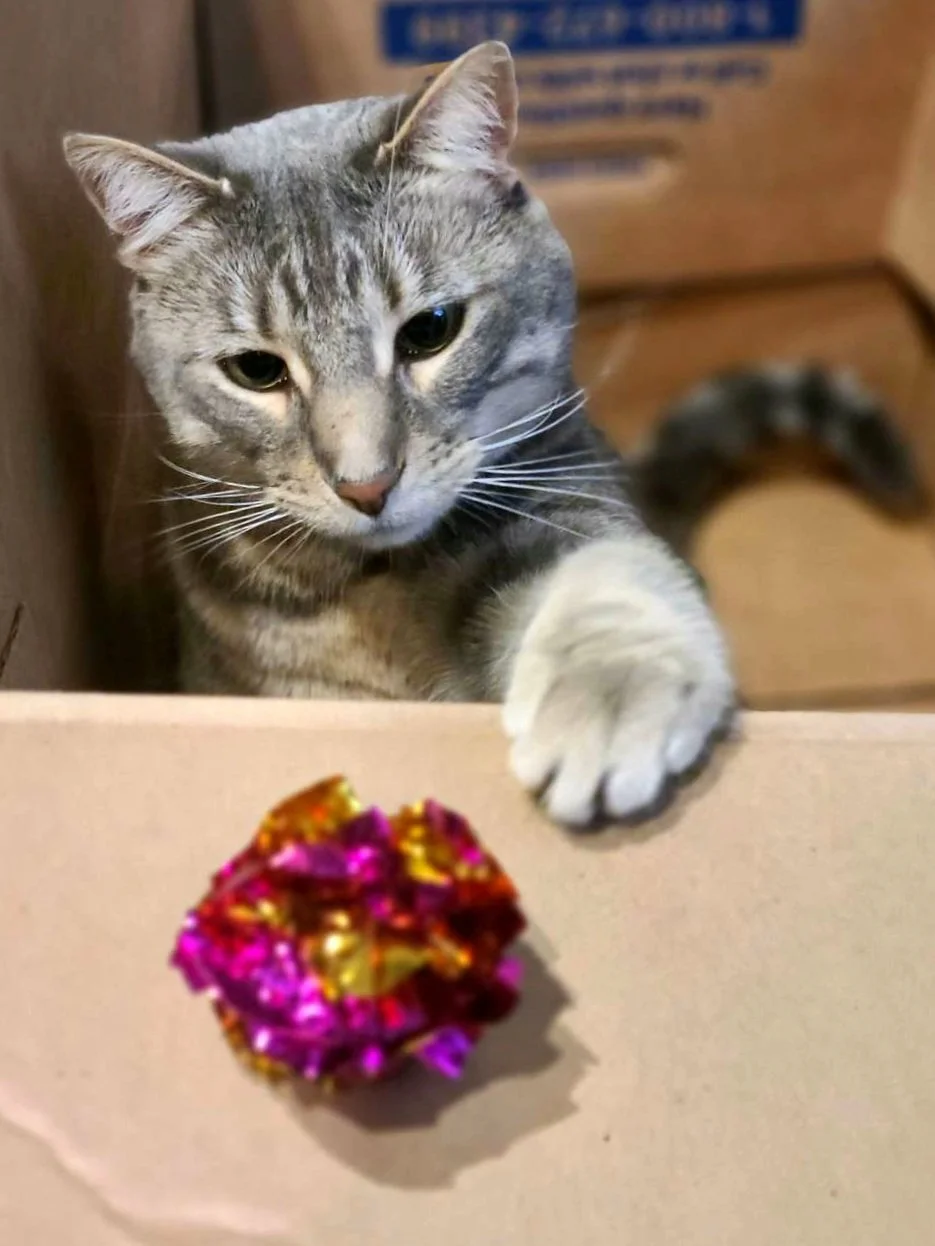
An enrichment guide for Player cats in Madison, Fitchburg, Middleton & Verona
If your cat launches a surprise ambush on your ankles at precisely the wrong moment, tears through the hallway at full sprint for reasons known only to them, or treats every bottle cap and hair tie as a legitimate toy, you might be living with a Player.
Player cats are the energetic extroverts of the feline world. They live for motion, interaction, and the particular satisfaction of a well-executed pounce. These are the cats who burst into zoomies without warning, materialize out of nowhere to bat a toy down the stairs, and approach the world with the kind of kinetic enthusiasm that makes a quiet evening feel like an adventure. What defines a Player cat isn't just their energy. It's the fact that movement is how they process the world. Play is how they regulate stress, build confidence, and express genuine joy.
Here's the thing most people don't know about Player cat behavior: it's not hyperactivity and it's not chaos. It's a biological circuit running its program. Cats are hardwired for a specific predatory sequence, stalk, chase, pounce, catch, and Player cats have a particularly strong drive to complete it. When that drive is met with real, intentional play, they settle beautifully. When it isn't, you hear about it at 2 AM.
If your cat took the Sploot Enrichment Quiz and landed as a Player, this guide is for them.
Is This Your Cat?
Player cats announce themselves clearly. A few reliable signs you're raising one: they're toy-obsessed, treating feathers, springs, crinkle balls, and errant socks with equal enthusiasm. They offer ambushes, hiding behind furniture, then launching out at whatever passes. They're drawn to fast movement: flickering shadows, moving feet under blankets, anything with unpredictable trajectory. They get bored with stationary toys quickly and reset by finding something new to stalk. And without enough outlet for all of that, they invent their own entertainment, usually involving your feet, your ankles, or something fragile on a shelf.
One nuance worth naming: some Player cats escalate quickly into rough play, biting or swatting that's not quite playful anymore. This isn't aggression. It's an overstimulated predatory circuit that needed more structure and a better ending. We'll come back to that.
Why Play Is More Than Fun
From a neurological standpoint, cat play closely mirrors the predatory sequence hardwired into feline brains: stalk → chase → pounce → catch. For Player cats, completing this sequence isn't just satisfying. It's regulating. Research reviewing the development and functions of cat play (Delgado & Hecht, 2019, Applied Animal Behaviour Science) found that play serves critical functions beyond entertainment, including stress reduction, emotional regulation, and the expression of natural predatory behavior that indoor life would otherwise leave unmet.
Importantly, a 2021 study by Pyari et al. published in Applied Animal Behaviour Science found that indoor-only cats show a stronger interest in predatory play stimuli than cats with outdoor access, suggesting that indoor cats may have a heightened drive to complete the hunting cycle precisely because their environment doesn't provide natural outlets for it. For Player cats already wired strongly toward motion and interaction, that finding has real implications. Intentional, structured play isn't supplemental care. For indoor Player cats, it's essential.
From a Fear Free perspective, what matters alongside the play itself is how it ends. A play session that stops abruptly, with the laser pointer switched off or the toy put away mid-chase, leaves the predatory sequence incomplete, which can produce frustration, redirected behavior, or the 2 AM zoomies. Ending every session with a physical "catch moment," a toy your cat can actually grab, bite, and bunny-kick, completes the biological loop and produces a genuinely settled cat afterward.
Setting Up Your Home for a Player Cat
Player cats need a home that accommodates movement, supports the hunt, and provides variety across toy types and play locations.
Clear runways matter. Player cats need space to sprint, and a hallway or open living area without obstacles lets them express that safely. This doesn't mean minimalism, just intentional furniture arrangement that leaves movement corridors open.
Toy stations throughout the home beat one big toy basket in the corner. Distributing a few toys across different rooms means your cat encounters fresh "prey" at different points during their patrol, maintaining novelty and encouraging natural stalking behavior throughout the day.
Vertical jumping opportunities support the predatory circuit too. Cat trees, stable shelves, and elevated perches give Player cats launchpads for pouncing, landing spots to retreat to, and the kind of three-dimensional movement that mirrors how cats actually hunt. A cat who can jump up and across, not just run forward, is a more physically and mentally satisfied cat.
Toy rotation is the most overlooked Player cat strategy. A crinkle ball left on the floor for a week becomes invisible. Rotated out and back in after a few days, it's prey again. Keep several sets of toys in a closed drawer and cycle them every few days. This costs nothing and dramatically extends the enrichment value of what you already have.
8 Enrichment Ideas Player Cats Love
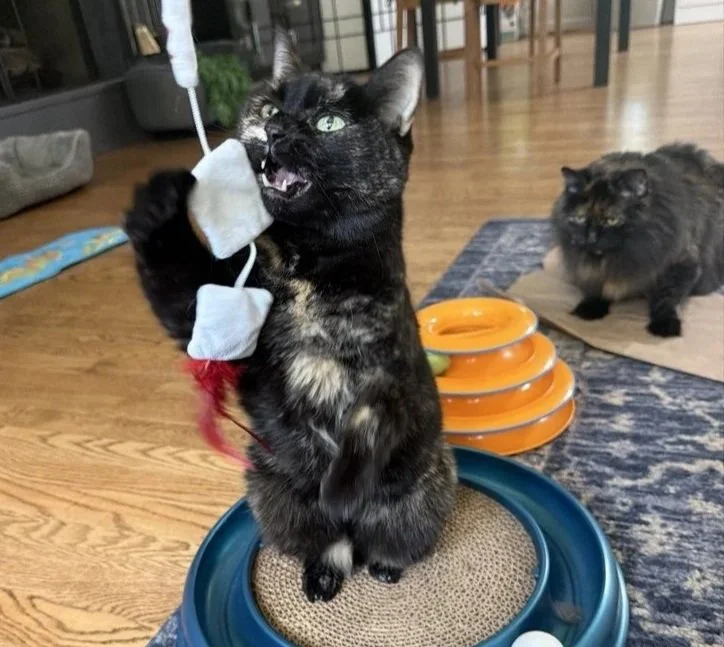
Wand toy sessions with a proper ending. The wand toy is the gold standard for Player cats because it lets you replicate the full predatory sequence: slow stalking movements to build anticipation, then chase, then a catch your cat can actually grab. The key is the ending. Don't just put the toy away. Let your cat catch it, hold it, bunny-kick it, and feel the satisfaction of a completed hunt before the session winds down. Five to ten minutes of this, done well, produces a noticeably calmer cat than thirty minutes of chaotic waving.
Tunnel ambush setup. A fabric crinkle tunnel positioned at the end of a clear runway gives Player cats a place to hide, stalk from, and launch from, which is exactly how they want to play. Drag a toy past the tunnel opening and watch the sequence activate naturally. Rotate tunnel positions every few days to keep it feeling like new territory.
Crinkle ball scatter. Lightweight crinkle balls are one of the best solo enrichment tools for Player cats because they move unpredictably when batted and make the kind of sounds that engage hunting attention. Scatter several across the floor before you leave for work. Your cat will redistribute them according to their own patrol priorities.
Interactive feather rotation. Loose feather toys, spring toys, and small plush mice get the most engagement when they're rotated rather than left out permanently. Keep three or four in a drawer, swap one in fresh every few days, and your cat treats familiar toys as new prey. Small investment, significant payoff.
Two-room play chase. Take a wand toy from room to room, letting your cat chase you and the toy through their territory. This mimics the experience of tracking prey across varied terrain and gives Player cats the movement variety their predatory circuit is actually looking for. It also builds the human-cat bond in a way that solo toy play doesn't.
Puzzle feeder after play. Ending an active play session with a puzzle feeder, your cat working for their meal immediately after the "hunt," completes the behavioral sequence in the most natural way possible: hunt, catch, eat. This transition from high-arousal play to focused foraging is genuinely calming and mirrors the natural rhythm cats evolved around.
Vertical launch course. A cat tree, a stable ottoman, and a cushioned landing point arranged in sequence give Player cats a safe environment for the jumping, bounding movement that's part of their full physical repertoire. This isn't agility training. It's just giving their body what it's designed to do.
Cardboard box ambush arena. Cut entry holes in two or three cardboard boxes positioned near each other and let your cat use them as hunting blinds. Drag a toy past the openings. Player cats will reorganize their strategy after every few attempts, which keeps the engagement genuinely active rather than repetitive.
How Sploot Pet Concierge Supports Player Cats
Our in-home cat sitting visits for Player cats are built around real play, not a quick toy wave and a treat. That means dedicated wand toy sessions that follow the predatory sequence properly, toy rotation to keep things novel visit to visit, and structured play endings that actually settle your cat rather than leaving them amped up. We serve Player cats across Fitchburg, Madison, Middleton, and Verona, and we pair each cat with a small, consistent caregiver team who learns how they play: how long before they escalate, what toy types engage them most, and what their post-play settling routine looks like.
For Player cats who have developed rough play habits, such as biting, swatting, or difficulty disengaging, our Fear Free Certified approach works on building more structured play patterns gradually, without punishment, because rough play is almost always a signal of unmet enrichment needs rather than a temperament problem.
Ready to Give That Predatory Drive Somewhere to Go?
Player cats are some of the most entertaining, most energetic, most joyfully alive animals you can share your home with. They just need play that's intentional enough to actually satisfy them. If you're ready to book Fear Free Certified care for your Player cat in Dane County, we'd love to meet them.
Also explore: The Sploot Enrichment Quiz | In-Home Cat Sitting | Cat Care
